


Manure Treatment
Manage continuously generated manure within an enclosed and controlled treatment system, helping reduce storage pressure, odor and uncontrolled methane emissions.
Cattle Manure
Pig Manure
Poultry Manure
Mixed Farm Organic Waste
BIOWATT-BIOGAS provides one-stop biogas solutions for the treatment and energy recovery of livestock and poultry manure. Our systems can be engineered for a wide range of feedstocks.
Different manure feedstocks require different preparation methods. BIOWATT-BIOGAS configures the feedstock receiving, impurity removal, mixing, homogenization and feeding stages around the actual material conditions. Once properly prepared, the feedstock enters the BIOWATT-BIOGAS CBD anaerobic digestion system for controlled biogas production.
From feedstock preparation and anaerobic digestion to gas storage, desulfurization, energy utilization and process control, BIOWATT-BIOGAS integrates the principal plant sections into one coordinated solution for commercial farms, agricultural enterprises and industrial biogas projects.
From feedstock preparation and anaerobic digestion to gas storage, desulfurization, energy utilization and process control, BIOWATT-BIOGAS integrates the principal plant sections into one coordinated solution for commercial farms, agricultural enterprises and industrial biogas projects.
SOLUTION VALUE
Turn Animal Manure into Renewable Energy
Livestock and poultry operations generate large quantities of manure that must be collected, treated and managed continuously. Anaerobic digestion converts the biodegradable organic matter in manure into methane-rich biogas while creating a more organized route for digestate management.
For industrial farms and agricultural enterprises, a properly engineered manure biogas plant can connect three important project objectives:
Manure Treatment
Manage continuously generated manure within an enclosed and controlled treatment system, helping reduce storage pressure, odor and uncontrolled methane emissions.
Renewable Energy
Use treated biogas for electricity generation, combined heat and power, process heating or further upgrading, depending on the selected project configuration.
Resource Recovery
Integrate digestate into a broader nutrient-management or agricultural-use strategy according to feedstock quality and local requirements.
Applicable Feedstocks
Animal Manure Feedstocks We Process
BIOWATT-BIOGAS solutions are not limited to one livestock species or only three types of manure. Cattle, pig and poultry manure are highlighted because they represent common industrial applications. Other livestock manure and mixed farm organic feedstocks can also be evaluated.
The final system configuration is based on the feedstock’s actual characteristics, including daily quantity, moisture content, total solids, collection method, bedding content and impurity level.
Cattle & Dairy Manure
Cattle manure may include slurry, fiber, sand, bedding and milking-parlor wastewater. BIOWATT-BIOGAS configures the receiving, impurity removal, mixing and feeding stages according to the farm’s collection method and actual manure properties.
Relevant applications include cow manure digesters, dairy manure digesters and complete dairy farm biogas plants.
Pig & Swine Manure
Pig manure is commonly collected as slurry mixed with wash water. BIOWATT-BIOGAS adjusts solids concentration, mixing, homogenization and controlled feeding to prepare the material for stable CBD anaerobic digestion.
A pig manure biogas plant can combine manure treatment, odor management and renewable energy production within one integrated system.
Poultry Manure & Litter
Poultry manure and poultry litter may contain high solids, nitrogen, bedding, feathers, spilled feed and other materials. These characteristics require targeted impurity control and feedstock conditioning before digestion.
BIOWATT-BIOGAS configures the preparation process according to the material analysis so that poultry manure can enter the CBD system under manageable and consistent feeding conditions.
Other Livestock & Mixed Manure Feedstocks
BIOWATT-BIOGAS solutions can also be developed for other livestock and poultry manure, including sheep, goat, horse, duck, goose and rabbit manure, as well as suitable mixtures of manure and farm organic residues.
Suitability is evaluated according to the material’s physical and biological characteristics rather than animal species alone.
Feedstock Preparation
Different Manure Characteristics Require Different Preparation
The objective is not to use the same preparation line for every manure type. It is to convert variable raw manure into a more uniform and manageable feedstock for the BIOWATT CBD anaerobic digestion system.
After feedstock preparation, conditioned material enters the BIOWATT CBD anaerobic digestion system, where biodegradable organic matter is converted into methane-rich biogas in an enclosed and controlled environment.
Each CBD system is sized according to daily feedstock quantity, solids content, organic loading, local climate and required treatment capacity.
Process Flow
How a Complete Manure Biogas Plant Works
After feedstock preparation, conditioned material enters the BIOWATT CBD anaerobic digestion system, where biodegradable organic matter is converted into methane-rich biogas in an enclosed and controlled environment.
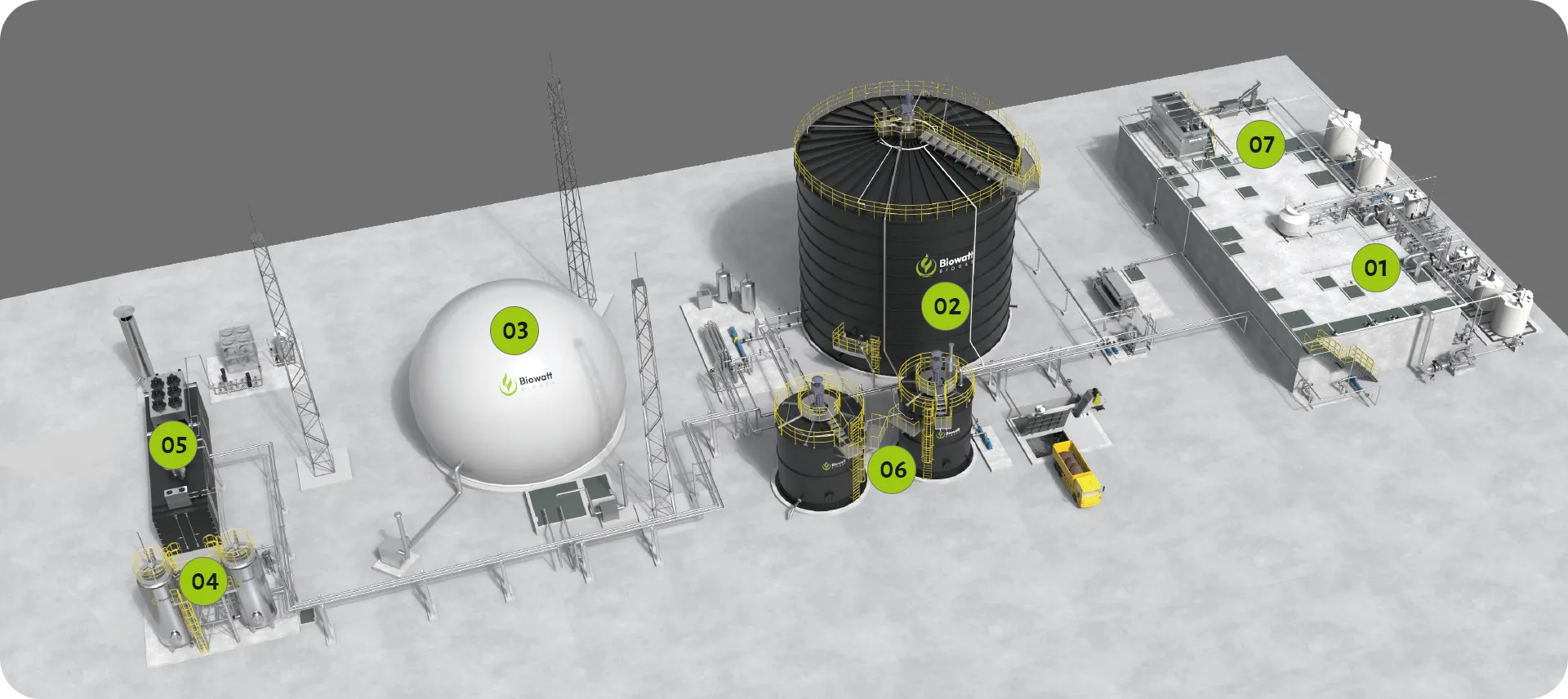
01 / RECEIVING
Manure Collection
Manure, slurry and associated farm wastewater are collected and transferred to the plant receiving section. Different feedstock streams can be managed according to their physical characteristics.
02 / PREPARATION
Feedstock Preparation
The raw manure is screened, mixed, homogenized or otherwise conditioned as required. Unwanted materials are controlled, and the feedstock is prepared for stable pumping and feeding.
03 / DIGESTION
CBD Anaerobic Digestion
Prepared feedstock enters the CBD system, where anaerobic microorganisms break down biodegradable organic matter and produce biogas under controlled conditions.
04 / STORAGE
Biogas Storage
The produced biogas is collected and temporarily buffered in a double-membrane gas holder, balancing continuous gas production with variable downstream consumption.
05 / TREATMENT
Desulfurization & Gas Treatment
Hydrogen sulfide, moisture and other unwanted components are controlled according to the gas quality required by the selected downstream application.
06 / UTILIZATION
Biogas Utilization
Treated biogas can support electricity generation, combined heat and power, process heating or further upgrading to biomethane.
07 / DIGESTATE
Digestate Management
Digestate leaving the CBD system can be separated, stored or prepared for subsequent agricultural use according to the project’s nutrient-management plan.
This section is designed for a full-plant system diagram, equipment layout or 3D process visualization with numbered callouts.
Biogas Utilization
Flexible Energy Utilization Options
Electricity Generation
After the required gas treatment, biogas can fuel a gas engine generator to produce electricity. The power can serve farm operations, processing facilities or other onsite loads and may be exported where grid conditions and local policy allow.
Combined Heat and Power
A CHP configuration produces electricity while recovering usable heat from the engine system. Recovered heat can support digester temperature control, farm processes, hot-water demand or other suitable thermal loads. The value of CHP depends on having a practical and consistent use for both electricity and heat.
Process Heat
Where electricity generation is not the main objective, treated biogas can be used as a fuel for suitable boilers or thermal processes. The gas-treatment and burner configuration must be matched to the intended application.
Biomethane
For projects targeting renewable gas, biogas can be routed to an upgrading system that removes carbon dioxide and other unwanted components. The final purification route depends on the required methane quality and whether the biomethane will be compressed, liquefied, injected into a gas network or used for another application.
Digestate Resource Recovery
Digestate retains nutrients from the original manure and can become part of a broader fertilizer or nutrient-management strategy. Its final handling method depends on feedstock quality, local agricultural demand and regulatory requirements.
After feedstock preparation, conditioned material enters the BIOWATT CBD anaerobic digestion system, where biodegradable organic matter is converted into methane-rich biogas in an enclosed and controlled environment.
Each CBD system is sized according to daily feedstock quantity, solids content, organic loading, local climate and required treatment capacity.
Project Delivery
One-Stop Project Delivery
Feedstock & Project Assessment
BIOWATT-BIOGAS reviews manure type, daily quantity, collection method, feedstock analysis, site conditions and the intended use of the biogas and digestate.
Process & Equipment Design
The preparation route, CBD capacity, gas-treatment requirements and major equipment configuration are developed according to the project data.
Equipment Supply & System Integration
The main process equipment is configured as one coordinated system, with the interfaces between feeding, digestion, gas handling, utilization and plant control considered during engineering.
Commissioning & Operational Support
Project support can include installation guidance, system commissioning, operator training and operational assistance according to the agreed project scope.
Why Choose BIOWATT-BIOGAS
Designed as One Complete Operating Plant
Feedstock-Specific Preparation
BIOWATT-BIOGAS recognizes that the primary engineering differences between manure projects often begin at the front end. The feedstock preparation system is configured around moisture, solids, impurities, collection method and feeding behavior.
Unified CBD Digestion Platform
After suitable preparation, different livestock and poultry manure feedstocks can enter the BIOWATT-BIOGAS CBD anaerobic digestion route. This combines customized front-end treatment with a unified digestion platform.
Integrated Plant Engineering
Feedstock treatment, digestion, gas storage, desulfurization, energy utilization and control are considered as connected parts of one operating plant—not as isolated equipment packages.
One-Stop Solution
BIOWATT-BIOGAS provides one coordinated solution from feedstock preparation to biogas utilization, helping project owners reduce interface risks and simplify communication across the main plant systems.
FAQ
What is a manure biogas plant?
A manure biogas plant is an industrial system that prepares animal manure and treats it through anaerobic digestion. The process produces biogas for energy use and digestate for subsequent nutrient or agricultural management.
What types of animal manure can BIOWATT-BIOGAS process?
BIOWATT-BIOGAS solutions can be engineered for a wide range of livestock and poultry manure, including cattle manure, pig manure, poultry manure and other suitable animal manure or mixed agricultural feedstocks. Final suitability and system configuration are determined through feedstock assessment.
Are BIOWATT-BIOGAS solutions limited to cattle, pig and poultry manure?
No. These three categories represent common industrial applications and important search topics, but they do not define the full feedstock range. BIOWATT-BIOGAS can evaluate other livestock manure and mixed farm organic materials based on their physical and biological characteristics.
Why is feedstock preparation important?
Raw manure can contain variable amounts of water, solids, sand, bedding, fiber, feathers and other materials. Feedstock preparation helps remove or control unsuitable impurities, improve uniformity and deliver a more stable feed to the anaerobic digestion system.
What is the difference between poultry manure and poultry litter?
Poultry manure primarily refers to bird excreta, while poultry litter normally includes manure mixed with bedding, feathers, spilled feed and other materials from the poultry house. Litter therefore requires a different preparation assessment from fresh or liquid manure.
Can different manure feedstocks be treated in the same plant?
Potentially, yes. Mixed feedstocks must be assessed for compatibility, solids concentration, impurity content, nutrient balance and feeding behavior. BIOWATT-BIOGAS uses this information to determine the preparation and operating strategy.
How can manure biogas be used?
After appropriate treatment, biogas can be used for electricity generation, combined heat and power, process heating or further upgrading to biomethane. The selected route depends on project economics, local infrastructure and the customer’s energy objective.
What information does BIOWATT-BIOGAS need to prepare a proposal?
The key information includes animal type, farm capacity, daily manure quantity, collection method, moisture and solids data, impurity content, project location, available site area and the intended use of the biogas and digestate.
Project Inquiry
Share your manure type, daily quantity, feedstock data, project location and intended energy use for an initial technical assessment.
Whether you are interested in leveraging our technology for your project, seeking a career with us, or require further information for any other reason, we are here to empower your sustainability goals.
Which solution do you want to know about?
Product Information
Quantity
Unit
Piece
Support order samples, customization, wholesale direct, and complete payment. If the product you look for does not have corresponding customized content, pls fill out the form below to contact us, and we will reply ASAP.


