


Biogas Upgrading to Biomethane: From Raw Biogas to RNG Systems
Apr 23, 2026
Biogas upgrading removes carbon dioxide and controls water, sulfur, and trace contaminants so raw biogas can become biomethane or renewable natural gas (RNG). The engineering target is not simply the highest methane percentage. It is the largest reliable flow of on-spec product, at the required delivery pressure, with acceptable methane loss and lifecycle cost.
The ranges below are for early project screening. Feed composition, outlet specification, utility prices, operating pressure, and the equipment boundary can materially change the result.
Raw Biogas, Cleaned Biogas, and Biomethane
|
Gas stage |
Typical methane level |
What has changed |
Common next step |
|
Raw biogas |
About 45–65% across a broad source mix; many digester streams are 50–75% |
Water, H₂S, particles, and source-specific contaminants remain |
Cleaning, or direct boiler/CHP use |
|
Cleaned biogas |
Usually close to the raw-gas methane level |
Moisture, sulfur, particles, siloxanes, or VOCs are reduced |
Boiler, CHP, or upgrader feed |
|
Biomethane or RNG |
Commonly about 95–99%; the buyer's specification controls |
Most CO₂ is removed and all regulated constituents are conditioned |
Grid injection, Bio-CNG, Bio-LNG, or industrial use |
Cleaning does not automatically make biomethane. Gas can be dry and low in sulfur while still containing 35–40% CO₂. A high methane reading also does not prove compliance if oxygen, nitrogen, dew point, sulfur, heating value, or delivery pressure misses the limit.
Data Required Before Sizing the Plant
Use a range and duration for each variable, not one average laboratory result:
· minimum, normal, peak, and future raw-gas flow;
· CH₄, CO₂, O₂, and N₂ on a stated wet or dry basis;
· average and peak H₂S, plus credible siloxanes, VOCs, ammonia, and halogenated compounds;
· product composition, dew point, heating value, pressure, metering, and off-spec procedure; and
· electricity, usable heat, water, annual operating hours, and the permitted residual-gas route.
A first-pass product-flow calculation is:
Biomethane flow = raw-gas flow × inlet methane fraction × methane recovery ÷ product methane fraction
For example, 1,000 Nm³/h of raw gas at 60% CH₄, upgraded to 97% CH₄ at 98.5% recovery, yields about 609 Nm³/h of biomethane. Purity describes the product composition; recovery describes how much inlet methane reaches that product.
How the Biogas Upgrading Process Works
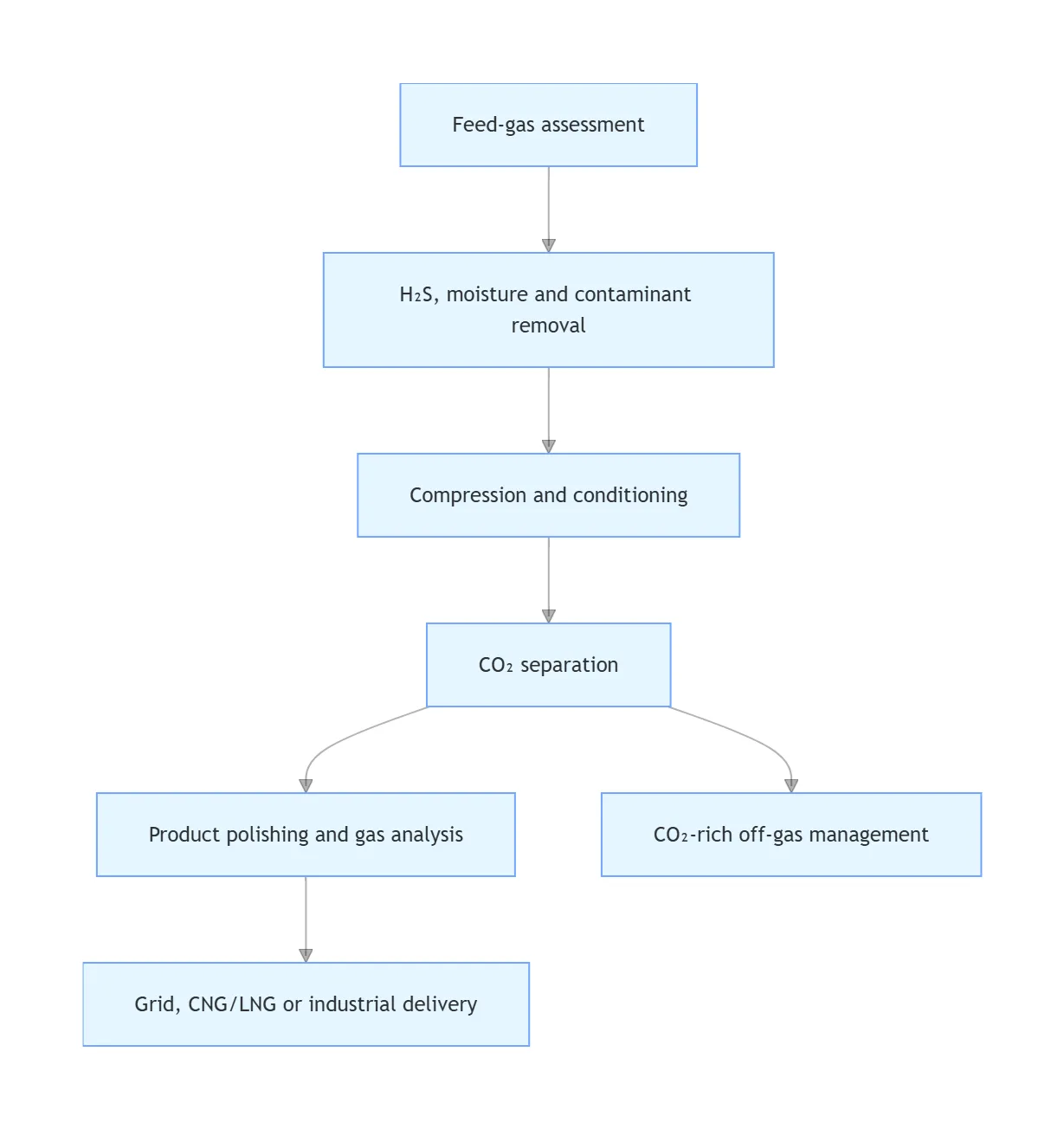
Measure and stabilize the inlet. Representative sampling defines the design envelope. Buffering and turndown control keep short flow peaks from overloading the separator.
Protect the upgrading unit. Match biological desulfurization, dry desulfurization, cooling, drying, and filtration to contaminant mass load—not ppm alone.
Separate CO₂ and recover methane. Membranes, adsorbents, water, or solvents raise methane concentration. Staging, recycle, regeneration, and pressure determine purity, recovery, and energy use together.
Verify every outlet. Online analysis routes conforming gas to the buyer and off-spec gas to recycle, storage, controlled use, or flare. The design must also account for CO₂-rich off-gas, condensate, and spent media.
The most common early-stage mistake is selecting the CO₂-removal package before fixing the product specification and the gas analysis.
Technology Comparison: Useful Screening Ranges
|
Technology |
Published flow range* |
Reported methane recovery* |
Indicative energy per Nm³ raw biogas** |
|
Membrane separation |
About 340–17,000+ Nm³/h for multi-pass systems |
About 96–99% |
About 0.30–0.50 kWh/Nm³ electricity |
|
Pressure swing adsorption (PSA) |
About 85–8,500+ Nm³/h |
About 95–98% |
About 0.15–0.30 kWh/Nm³ electricity; some boundaries add drying and final compression |
|
Water scrubbing |
About 85–5,100 Nm³/h |
Typically above 99% |
About 0.16–0.30 kWh/Nm³ electricity for compression, pumping, and cooling |
|
Amine absorption |
About 1,700–17,000+ Nm³/h for solvent systems |
Often above 99% |
About 0.12–0.21 kWh/Nm³ electricity plus roughly 0.55 kWh/Nm³ heat |
The flow and recovery figures are approximate conversions from a 2024 US EPA overview of landfill-gas projects; they are not universal size limits.
The energy figures are screening ranges compiled in a 2024 technical review. Different pressure, drying, recycle, and delivery boundaries prevent direct comparison.
All four routes can produce compliant gas when correctly configured. Compare bids at the same inlet composition, product pressure, methane-recovery boundary, annual availability, and residual-gas scope. See the membrane biogas upgrading guide for stage and recycle design in more detail.
A Practical Technology Shortlist
Shortlist membranes when footprint is restricted, modular installation is preferred, flow may expand in stages, or unattended operation matters. Confirm pretreatment and the recovery-versus-recycle tradeoff.
Shortlist PSA when gas can be kept consistently clean and dry, water or chemical use is undesirable, and cyclic equipment is acceptable. Check valve duty, adsorbent life, and tail-gas treatment.
Shortlist water scrubbing for steady medium-to-large flows where water, cooling, and wastewater management are straightforward. Check dissolved methane and seasonal cooling demand.
Shortlist amine scrubbing when selective CO₂ removal and very low process slip are valuable and low-cost heat is available. Include solvent management, corrosion control, and product recompression.
Stop and solve the inlet first when nitrogen or oxygen is high. Standard CO₂ removal does not automatically remove enough inert gas.
Design backward from Bio-LNG or saleable CO₂ when either is a planned product. Liquefaction and CO₂-purity requirements can change the preferred upstream process.
Why Methane Slip Needs Its Own Guarantee
Methane slip is methane that leaves the upgrading process with CO₂-rich off-gas instead of the product. It is lost revenue and a climate issue: methane has about 28 times the warming impact of CO₂ over 100 years and about 84 times over 20 years.
A 2025 IEA Bioenergy review reports that process slip before post-treatment tends to be above 1% for PSA and water scrubbing, around 0.5–1% for membrane systems, and below 0.1% for amine scrubbing. These are technology directions, not guarantees. They do not map one-for-one to the EPA recovery figures above because published sources use different recycle and off-gas boundaries. Process slip must also be separated from fugitive leaks and venting during trips or maintenance.
Controls include additional membrane stages, recycle to the upgrader, recovery through CO₂ liquefaction, use in a suitable CHP system, and regenerative thermal oxidation. A vendor guarantee should state methane recovery, off-gas composition, and the treatment boundary—not only product purity.
What Does Biogas Upgrading Cost?
Cost numbers are meaningful only when their scope is clear. The IEA's 2025 global analysis places 90% of biomethane production potential at USD 10–30/GJ—about USD 36–108/MWh—but that is total biomethane production cost, not an upgrading-package quote. A 2023 European study using operating-industry data found average biogas-production-plus-upgrading costs of €54/MWh for larger plants and €84/MWh for smaller plants.
For a current budget, separate four numbers: the upgrader package; pretreatment and off-gas control; civil, electrical, and connection works; and annual operating cost. Normalize proposals to the same annual hours, utility prices, delivery pressure, recovery, redundancy, and maintenance allowance. The biogas upgrading equipment guide provides the detailed battery-limit checklist.
Standards and the Proposal Test
EN 16723-1 addresses biomethane for European gas networks, while EN 16723-2 covers automotive fuel. In the United States, the pipeline tariff and interconnection agreement define acceptance. Credit schemes are a separate qualification exercise; do not place incentive revenue in the base case until eligibility, metering, and chain-of-custody duties are confirmed.
Ask every bidder to state the feed basis, included energy loads, guarantee conditions, complete methane balance, and annual saleable output after downtime and off-spec rejection. A proposal can meet purity and still fail on recovery, energy boundary, or delivered volume.
Conclusion
Biogas upgrading is a specification-driven gas-processing project, not a contest for the highest methane percentage. Start with representative gas data and the buyer's specification. Then compare technologies on saleable biomethane, methane loss, utilities, availability, and lifecycle cost using one common boundary.
If that screen points toward a modular membrane configuration, evaluate a containerized membrane upgrading system against the same mass balance and acceptance test—not as the default answer for every site.
Biogas upgrading to biomethane solutions for your project!
For tailored biogas upgrading solutions, feel free to contact our team.
Email: sales@biowatt-biogas.com | WhatsApp: +86 138 1203 3566
Choose the most suitable solution for you
Whether you are interested in leveraging our technology for your project, seeking a career with us, or require further information for any other reason, we are here to empower your sustainability goals.
Which solution do you want to know about?


Product Information
Quantity
Unit
Piece
Support order samples, customization, wholesale direct, and complete payment. If the product you look for does not have corresponding customized content, pls fill out the form below to contact us, and we will reply ASAP.

